
Case 03. Image x Production Management
Nanomaterial Assessment
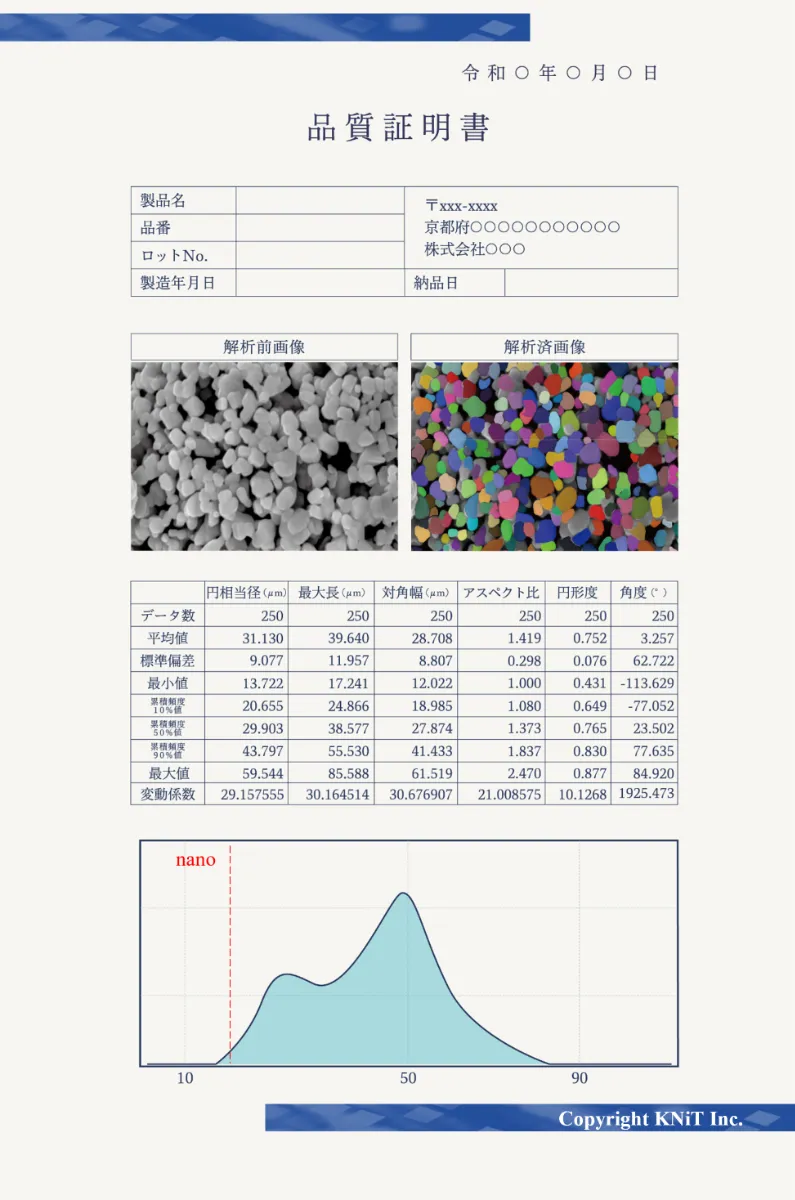
Making nanomaterial quality certification
dramatically faster and more affordable.
Nanomaterials are substances or structures at the nanometer (nm) scale, whose extreme smallness gives them unique functions and properties not found in conventional materials. They are expected to be applied in a wide range of fields including sunscreen, cosmetics, medicine, and electronics, while research on their safety for humans and the environment is also advancing.
Traditional Challenges
Due to their high functionality, nanomaterials are used in a wide range of products such as cosmetics, paints, and resin fillers. However, their potential impacts on marine ecosystems and the human body are debated. In Europe, the 2022 European Commission recommendation clearly redefined 'nanomaterial,' establishing criteria such that 50% or more of particles (by number) must fall within the 1–100 nm range.
Reliable evaluation is therefore required across industries. In cosmetics in particular, the EU Cosmetics Regulation requires 'nano' labeling for ingredient names, so objective evidence showing whether each ingredient is nano is essential—yet on-site evaluation remains challenging. Bulk methods such as DLS (dynamic light scattering) struggle to measure particles above 3 µm, and particle-size analyzers alone cannot deliver the precision needed for nano-scale judgments. Manual measurement from SEM/TEM images is extremely time-consuming and suffers from analyst-to-analyst variability. An objective and fast nanomaterial assessment method is needed.
How Our Technology Solves It
GeXeL segments particles in SEM/TEM images and instantly extracts geometric parameters such as equivalent circular diameter, aspect ratio, circularity, and orientation. Statistical processing yields the particle-size distribution, and the service produces reports including the basis (100 nm threshold and number-based particle fraction) required for 'nano/non-nano' judgments aligned with the European definition.
AI automation eliminates manual variability, returning key indicators such as particle count, size, shape, and aggregation ratio within minutes of image upload, resolving the bottlenecks of conventional methods. In addition, GeXeL automatically generates quality certificates documenting the 'nano/non-nano' judgment.
GeXeL outputs results in a traceable format that includes the measurement images, analysis conditions, and judgment logic, making them ready for internal and external review and audit.

Applications to Other Cases
This technology can be applied not only to cosmetics (foundations, sunscreens, etc.), but also to pigments, paints, inks, resin fillers, conductive additives (e.g., carbon black), functional powders including zinc oxide and titanium oxide, catalyst supports, ceramics, and packaging materials—essentially any field handling nano- to submicron-scale particles.
By objectively evaluating number-based particle-size distributions from SEM/TEM images, GeXeL reveals worlds that have been invisible until now.
Feel Free to Contact Us
Want to solve challenges with GeXeL's image analysis?