
Case 02. Image x Food
Food Texture Evaluation through Bubble Structure Analysis
Texture is a critical factor in tastiness, but it has traditionally relied on sensory evaluation by experts. GeXeL enables objective texture evaluation by analyzing bubble structure.
Traditional Challenges
Food textures such as 'fluffy,' 'chewy,' and 'crisp' in bread and other products have long depended on sensory evaluation by experts. Sensory evaluation makes it difficult to ensure consistency and reproducibility, and the transfer of know-how when personnel change is also a challenge.
Manually measuring bubbles or tissue from microscope images—even with length-measurement software—requires significant time and effort, and the precision of image analysis has limits, as adjacent bubbles are often mistakenly connected. As a result, R&D and quality control criteria end up depending on subjectivity, leading to prolonged development cycles and quality variability.
How Our Technology Solves It
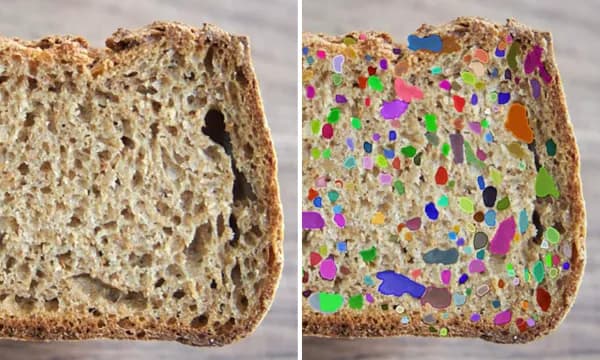
GeXeL solves this problem by precisely segmenting only bubble regions from cross-sectional bread images. Simply upload an image and, within minutes, obtain a full set of geometric parameters including bubble density, size distribution, shape (circularity, aspect ratio), orientation (anisotropy), and porosity.
Geometric parameters considered important to bread texture include
(1) porosity and cell wall thickness (thinner walls tend to produce softer textures),
(2) bubble size distribution and number density (indicators of fineness/coarseness),
(3) shape metrics (circularity, aspect ratio),
(4) orientation/anisotropy (direction dependence of mechanical response),
(5) bubble connectivity (degree of open-cell structure).
These geometric parameters have been systematically related to mechanical properties (hardness, elasticity, chewing deformation behavior) and sensory characteristics. It has been reported that micro-structures quantified by image analysis correspond to physical indicators of texture[1]. Bubble coalescence during baking has also been shown to widen size distribution, contributing to coarse pores and crumb heterogeneity[2].
In our validation, a correlation has been obtained between cell orientation and 'crispness.' This makes it possible to describe sensory expressions such as 'dominant elongated bubbles with strong pull' or 'rounded shape with good crispness' using geometric parameters, and to rapidly explore causal relationships between formulation, fermentation/baking conditions, and texture.
Applications to Other Cases
Under the common framework of 'quantifying texture from images,' this technology extends to noodles (optimizing firmness/crispness via bubble, starch, and gluten network evaluation), beer and carbonated beverages (quantifying foam formation, retention, and bubble-size distribution), cultured and alternative meats (understanding the relationship between tissue arrangement, cell density, porosity and mouthfeel), and frozen foods (visualizing cell disruption and texture changes by comparing cellular images before and after freezing).
By supporting the development of 'new textures and flavors' never before realized, GeXeL weaves new value into society.
References
- [1] Scanlon MG, Zghal MC. Bread properties and crumb structure. Food Research International. 2001;34(10):841–864.
- [2] Wang S, Austin P, Bell S. It's a maze: The pore structure of bread crumbs. Journal of Cereal Science. 2011;54(2):203–210.
Feel Free to Contact Us
Want to solve challenges with GeXeL's image analysis?